A carton that passes a drop test on the floor can still fail inside a container, because the forces are different. On the road and at sea, cargo experiences long, low-frequency vibration, repeated braking and cornering, roll and pitch, and thousands of small impacts over 20, 30, 40 days. A loose load doesn’t get one hard hit. It gets worn down — carton by carton, corner by corner, until a seam splits, a crush margin disappears, or a stack tips.
And the empty space is what makes it possible.
Why the usual fixes keep failing?
“We stuffed it with spare cartons.”
Cardboard fill compresses. It absorbs moisture. It has no predictable resistance, so it looks fine at loading and useless at delivery.
“We used wooden braces and nails.”
Solid, yes — but time-consuming, inconsistent between loaders, damaging to pallets and goods, and it still doesn’t adapt to irregular voids.
“We packed tighter and stacked higher.”
This trades one risk for another. Higher stacks raise the centre of gravity and increase compression on the bottom layer. Tighter packing without restraint just means more mass moving together.
“We’ll fill the rest at the end.”
The end of the container is exactly where the space is least predictable — and where the load is least supported.
The common thread: all of these treat the gap as leftover space to be filled, rather than as a structural gap to be braced.
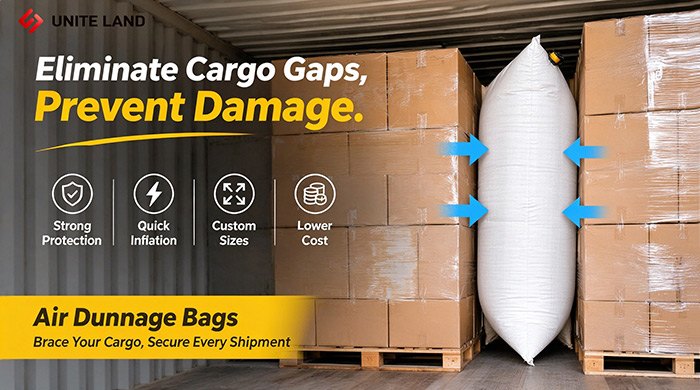
What proper air dunnage bag actually does?
Based on your application and budget requirements, UniteLand offers container air dunnage bags in kraft paper, PP woven, and double-layer PE constructions. We also offer a range of valve options to keep your packing process running smoothly — including the standard Valve B for everyday use, the ultra-fast inflation Valve C, and the flexible Film Valve for convenient inflation and deflation. Sizes can be customized as well. Among our standard specifications, the maximum height currently available is 2.4 meters (uninflated dimensions).
Uniteland air dunnage bags are rated to withstand over 5 tons of pressure. The one-way air valve inflates fast and seals almost without back-leak, so the pressure you set on the dock is the pressure that arrives at destination.
Inflate on-site, in seconds — place the air dunnage bag in the void, inflate, and it expands to brace the load against the container walls. No shifting, no swaying.
High burst strength you can actually trust — built with reinforced kraft paper / PP woven layers, our bags withstand the pressure of a fully loaded container, not just the lab.
Right size, right void — available in multiple sizes and levels to match your gap, from small inter-pallet spaces to large voids near the container doors.
Lower cost than damage — one air dunnage bag costs a fraction of a single damaged pallet. The math isn’t complicated.
The Four Mistakes We See Most Often
We’ve walked a lot of loading docks. These four errors show up again and again:
- Choosing the bag by habit, not by measurement. “We always use 1000×1800” is a sentence that ends in claims. Bag width should follow the void width; bag length should follow the stack height and pallet depth.
- An air dunnage bag inflated to maximum stiffness has no margin left for heat and pressure changes. Aim for firm but slightly compressible — roughly 80% of full inflation. If it feels like a balloon about to pop, it’s wrong.
- Placing bags against sharp edges. Wooden pallets, nail heads, steel corners, and protruding straps are the number one cause of punctures. Put a smooth barrier — corrugated board or a flat panel — between the bag and anything sharp.
- Stacking air dunnage bags in the same void. Two bags side by side or one on top of another tend to shift and bounce against each other in transit. One correctly sized bag, properly positioned, beats two improvised ones.
How to Size an Air Dunnage Bag?
You only need three measurements:
Void width — the gap you need to fill, measured after the container is 90–95% loaded.
Void height — the usable height of the stack or the space between cargo layers.
Void depth — the depth of the pallet or package facing the gap.
Curious which UniteLand air dunnage bag fits your typical shipment? Share your cargo type, average gap size, and transport route, and we’ll send you a tailored recommendation plus a free warehouse packing checklist for your team.