When a buyer tells us air column packaging “didn’t work,” it almost never means the concept is wrong. It usually means one of a handful of specific things went wrong in material choice, product prep, or handling. The good news is that every one of them is fixable before you ship a single carton.
Here are the reasons we see most often, and what to do about each one.
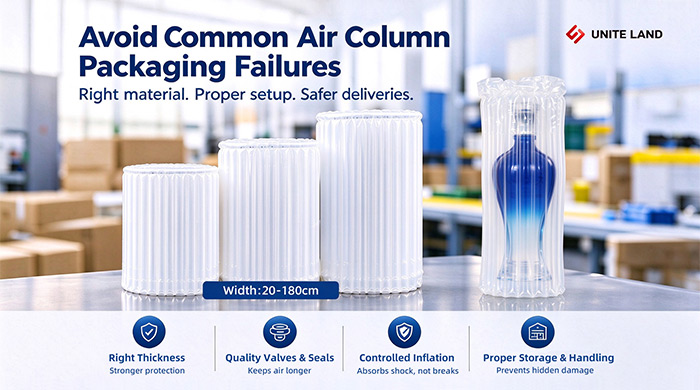
- You Specified the Wrong Film Thickness
The single most common cause of failure is using a gauge too thin for your product weight and shipping conditions. Many buyers default to the cheapest 60μm film for everything, but thickness directly dictates puncture resistance and load capacity.
Lightweight cosmetics and supplements: 60 microns is sufficient
Electronics, small appliances and glass bottles: 75 microns is the practical minimum
Heavy industrial parts, automotive components and large appliances: 100-120 microns is required
Thinner film saves pennies per roll, but it tears far more easily on sharp edges and fails to hold pressure under sustained compression in sea freight containers. PackBest offers air column film in thicknesses ranging from 50 microns to 120 microns to meet the diverse packaging needs of different customers.
- 2. Inferior One-Way Valves & Weak Heat Seals
Slow, gradual deflation over 24–72 hours almost always traces back to two manufacturing defects:
Poor valve quality: Low-cost valves fail to seal completely after inflation, causing micro-leaks that are invisible at first but leave columns soft by arrival.
Weak heat seals: Inconsistent sealing temperature or pressure creates weak seams along columns or edges. Internal air pressure pushes these seams open over time, especially in warm shipping environments.
PackBest’s patented multi-layer air valve technology significantly reduces slow air leakage in air column packaging, sustaining air pressure longer and delivering longer-lasting protective performance.
- Over-Inflation & Unregulated Air Pressure
More is not better when it comes to inflation. Over-inflated columns become rigid and brittle – they pop on impact instead of absorbing shock. It also puts excess stress on heat seals and valves.
This is especially common when using unmatched compressors or air column machine with no pressure regulation.
- Poor Storage & Rough Handling On-Site
Not all failures happen on the truck. Many start in your own warehouse:
Storing rolls in direct sunlight or near heat sources degrades the plastic over time, making it brittle.
Rolling or dragging film across concrete work surfaces introduces micro-scratches and pinpricks from grit and debris. All of these create latent risks of slow air leakage over time and impair the protective performance of air column rolls.
Customisation That Actually Changes Your Numbers
Not every custom option is worth paying for. These are the ones that tend to move the needle:
- Column height from around 15 cm up to 180 cm, so the wrap matches youritems’ length.
- Film thickness around 20to 120 microns as a standard, stepping up for heavy industrial parts or rough multi-leg routes.
- Easy-tear perforations set to your carton length, which removes measuring and scissors and makes packing repeatable for new staff.
- Brand colours and single-colour logo printing, which turn a utilitarian wrap into part of the unboxing experience.
Why Most Failures Are Entirely Avoidable
Air column cushion roll is an extremely reliable protective packaging solution – when it’s specified correctly and made properly. Most failures come from buying on price alone, ignoring thickness, valve quality, and construction.
At UniteLand Packaging, every roll is engineered to match your specific product weight, dimensions, and shipping route. If you’ve had issues with air column film roll failing in the past, don’t write off the technology. Send us your product details and shipping profile, and we’ll recommend the exact gauge, valve type, and column size that will eliminate damage returns. Free sample rolls are available for on-site testing.