Paper or plastic?
Your real question shouldn’t be which material category looks better on a sustainability checklist. It should be this: Which protective solution matches your product, your shipping route, your order volume and your compliance obligations?
At UniteLand Packaging, we don’t push one universal “best” cushioning. We offer two complementary on-demand systems — our paper cushioning packaging solutions and our air cushion packaging solutions — and each shines in distinct packing scenarios. The smarter strategy is knowing when to deploy which, or where they work best together.
Let’s break this down practically.
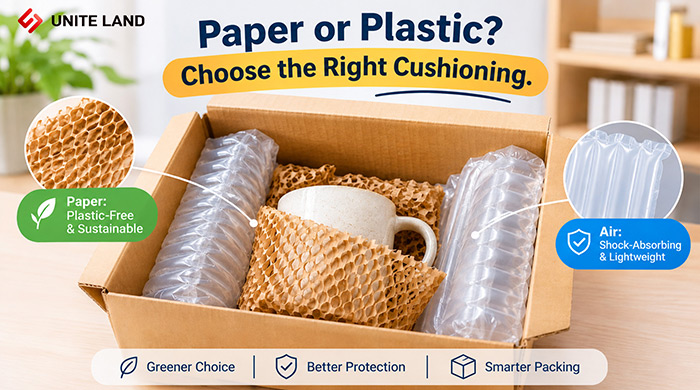
UniteLand paper cushioning packaging such as honeycomb paper sleeve is the better pick when your brand needs a fully plastic-free unboxing experience, and your products have irregular, handcrafted or contoured shapes: hand-thrown ceramics, wooden home decor, custom artwork, premium skincare gift sets and artisanal goods all benefit.
Paper cushioning is also ideal for brands targeting markets with strict plastic bans, premium retail unboxing, or customer bases that actively reject any plastic in their parcels. If you ship shorter domestic routes, with fewer sorting hubs and fewer violent drops, paper delivers dependable cushioning while checking every box for curbside recyclability.
That said, paper absorbs moisture, so it is less reliable for long ocean shipments, humid cross-border lanes, or goods that cannot tolerate dampness. Under repeated heavy impact, compressed paper loses its cushioning structure.
This is exactly where our on-demand air packaging steps in.
Our air cushion films, air column bags inflate on demand, from flat compact rolls that occupy only a fraction of your warehouse space. They are your go-to when consistent shock absorption, ultra-light weight and packing speed are your top priorities.
High-volume e-commerce, glassware, precision electronics, bottled cosmetics and standardized retail inventory are classic fits. Each air chamber delivers predictable, repeatable impact resistance across rough multi-carrier networks, long international journeys and cross-border fulfilment. Since air packaging barely adds weight to the parcel, it directly cuts incremental shipping costs — a huge win for sellers whose margins vanish into dimensional-weight surcharges. It also works beautifully for automated packing lines, where packers need clean, tearable, ready-to-use protection at scale.
UniteLand heavy-duty container air dunnage bags are a separate use case: stabilizing shifting cargo inside full sea containers, where paper simply cannot deliver the required blocking and bracing force.
And the hybrid workflow? That is where many of our happiest customers land.
A premium homeware brand might wrap irregular wooden ornaments with UniteLand paper cushioning for a plastic-free unboxing, then line the remaining void with air dunnage bags to lock the whole assembly away from box walls and absorb transit vibration. A glassware seller may use air columns as the primary shock layer, then add a thin paper wrap to prevent surface scuffs and soften the unboxing moment. This hybrid approach lets you protect high-risk goods, control freight weight, honour your sustainability promises and keep packing throughput high — without forcing a binary choice.
The choice is no longer paper or plastic. It is scenario-led, on-demand cushioning.
Ready to stop compromising? Let’s talk about how UniteLand can build a mixed protective packaging workflow matched exactly to your product range and shipping routes.