On 12 August 2026, the EU Packaging and Packaging Waste Regulation (PPWR) officially came into force, replacing a 30-year-old directive framework. For anyone shipping products into the European market — whether you’re a brand owner, a fulfilment centre, or a cross-border seller — this isn’t a distant “sustainability initiative.” It’s a market access condition.
Here’s the part that directly hits your packing line: under Article 24, grouped, transport, and e-commerce packaging must not exceed a 50% empty-space ratio by 1 January 2030. And critically, all filler materials — air cushions, bubble wrap, foam peanuts, paper crinkle — count as empty space.
The message is clear: right-sized packaging with engineered structural cushioning is no longer optional. It’s the new baseline.
Why “More Material” Was Never the Answer
For years, the logic on many packing floors was simple: more layers, more tape, more filler equals safer delivery. And yet:
- 3-4% of all U.S. e-commerce shipments arrive damaged, contributing to billions in annual losses.
- 51% of consumers won’t buy from you again after receiving a damaged product.
- Damage-related returns account for roughly 20% of all e-commerce returns, most of which are entirely preventable.
Here’s the uncomfortable truth: the material you’re adding isn’t stopping the damage. The structure is what matters — or rather, the lack of it.
The Structural Fix: How Honeycomb Paper Sleeves Work
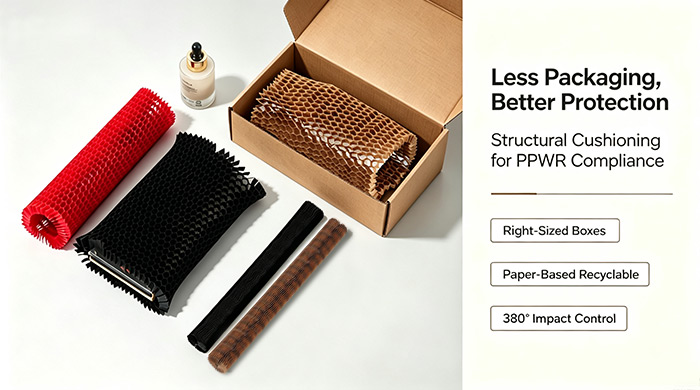
At UniteLand Packaging, our honeycomb paper sleeves are built on a simple principle borrowed from nature: the hexagonal cell. High-strength kraft paper is precision slit and stretched into a three-dimensional hexagonal grid that functions like thousands of tiny shock absorbers. When a parcel is dropped, the cells compress and dissipate energy evenly, then spring back to maintain their protective volume.
What does that mean on your packing bench?
No loose fill. No air pillows. No tape-heavy wrapping rituals. The sleeve simply stretches over your product and grips it in place — edge to edge, corner to corner
What This Means for PPWR Compliance — and Your Bottom Line
Let’s map the honeycomb paper sleeve directly against the PPWR’s empty-space rules:
| PPWR Challenge | Honeycomb Paper Sleeve Response |
| Oversized boxes push you over 50% | The sleeve conforms to product shape, enabling right-sized cartons |
| Recyclability requirements tightening | 100% paper-based, fully recyclable in standard paper streams |
| EPR fees penalise hard-to-recycle formats | Mono-material paper packaging attracts lower producer fees |
| Oversized boxes push you over 50% | The sleeve conforms to product shape, enabling right-sized cartons |
But compliance is just the entry ticket. The real question is: what does this do to your total packaging cost?
Less material purchased. Fewer SKUs in your packaging inventory. Smaller cartons means lower dimensional weight — which means lower freight charges. Faster packing because your team isn’t wrestling with three layers of bubble wrap. And fewer damaged goods means fewer refunds, fewer replacement shipments, and fewer one-star reviews that kill your conversion rate.
“But Will It Actually Protect My Product?”
Honeycomb cells maintain consistent cushioning through long-distance shipping, stacking, and repeated handling. From glassware and ceramics to consumer electronics and premium skincare in glass jars — if it’s fragile, irregularly shaped, or high-value, the sleeve is designed for it.
The Shift Is Structural, Not Cosmetic
PPWR is not asking you to swap one filler for another “greener” filler. It’s asking you to rethink the architecture of your packaging. The era of compensating for bad box sizing with more material is ending. What replaces it is precision — packaging that fits the product, protects through geometry rather than volume, and returns value to your operation in the form of lower freight, faster fulfilment, and fewer returns.
Ready to see what a right-sized, PPWR-ready packing operation looks like? Reach out to UniteLand Packaging for a free consultation and a sample pack tailored to your product range. Your packing bench will tell you which side makes more sense.